 |
| Plaxico Burress won it all in 2008. One year later, he was serving time. |
Friday, August 19, 2011
The Plaxico Burress Saga: Earning A Fresh Start

Monday, August 15, 2011
The Debate Over Native American Mascots: Claims Of Racism Should No Longer Be Ignored
 |
| University of Illinois' fictional mascot Chief Illiniwek was banned by the NCAA in 2007. |
A new chapter was written last Thursday in their crusade.
Thursday, August 11, 2011
Colonials, No More: Yet Another Team Bails On Hartford
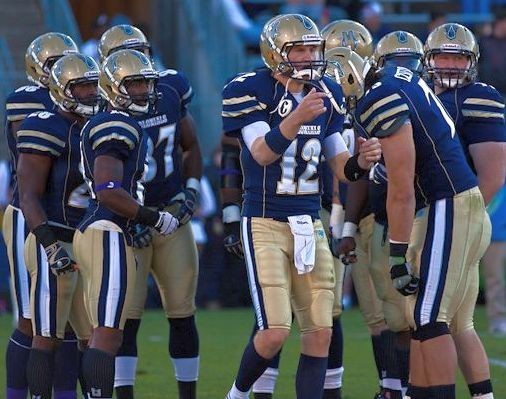 |
| No one outside Connecticut will read this article. |
But, does Connecticut really want them back?
Monday, August 8, 2011
Oscar Pistorius: The "Blade Runner" Eyes London Olympics
 |
| Oscar Pistorius sparked debate by recently qualifying for Worlds. |
Yet, there is a very outspoken constituency out there that doesn't want him to compete in the worlds' biggest events, doesn't think he should be allowed to run, to break records.
The native South African's unfair advantage? His Cheetah Flex-Foot carbon-fiber transtibial artificial limbs, a.k.a. the metal hooks attached to the double amputee's knees that allow him to run with the best in the world.
Who would've thought a man born into such physical disadvantage (absence of fibulae in both his legs) would be attacked on the basis of an athletic advantage he holds over the able-bodied runners of the world?
At this point in his career, Pistorius has faced all his critics, voluntarily submitting himself to rigorous physiological testing and routinely shooting down his detractors. He appeared in a "They said I couldn't..." Nike commercial, concluding with the defiant remark, "Anything else you want to tell me?"
Should he be allowed to enter able-bodied competitions? The debate heats up with every race in which Pistorius blows away the competition. After sweeping gold in the 100, 200, and 400 meter races at the Paralympic World Championships in 2006, Pistorius began creeping into international competition, with the goal of qualifying for the 2008 Summer Olympic games in Beijing.
However, on March 26, 2007, the International Association of Athletics Federations (IAAF) modified its rules to include a ban on the use of "any technical device that incorporates springs, wheels or any other element that provides a user with an advantage over another athlete not using such a device." At that time, the IAAF began conducting tests and studying the effect Pistorius' prosthetic limbs had on his running ability. German Professor Peter Brüggemann, who conducted a study for the IAAF in November 2007, concluded that the Cheetah "blades" allowed Pistorius to use up 25% less energy than athletes with full use of their legs, led to less vertical motion, and required 30% less mechanical work for lifting the body. Based on these studies, the South African was officially banned from competition on January 14, 2008, with the IAAF citing his blades as a "technical aid in clear contravention of IAAF rules."
Arguing that the IAAF made a "premature and highly subjective" ruling, Pistorius appealed to the Court of Abitration for Sport (CAS). He won his appeal, and on May 16 of that same year, the IAAF's ruling was reversed. Despite re-opening the window of opportunity, Pistorius failed to qualify for the Summer Olympics that year, coming up short against the best 400 meter runners in South Africa.
 |
| Pistorius has qualified for Worlds, London 2012 |
Now, it seems like every time he "threatens" to topple the world's best able-bodied competitors, that same constituency of experts and fans rush to determine whether or not his participation in these events is "fair." Roger Black, former British 400 meter runner, recently stated in a BBC interview that Pistorius should not race because "We are not seeing 'like' against 'like.'"
Experts aren't in complete agreement on the benefits and detriments of Pistorius' prosthetic blades, even including those on the panel who helped overturn the IAAF's decision.
Critics say he doesn't experience the lactic acid buildup that hinders the performance of able-bodied runners, his Cheetah blades return more energy per stride without becoming fatigued, and the lightweight blades allow for fewer strides in a race and quicker repositioning.
His defenders claim that his prosthetics are subjected to certain detrimental factors that natural legs are not, like difficulty with traction in rainy conditions, greater sensitivity to wind, and returning only 80% of energy absorbed in each stride (compared to 240% for normal legs).
But as each side attacks the factual evidence of the other, they overlook the most important aspect of the debate: Oscar Pistorius is different from other competitors, and it doesn't take scientific evidence to prove that. Watch the video above again. His pacing is radically different from the other runners. His prosthetics limit him to a slow start, but he seems to accelerate for a longer period. The real question is, will the net gain or net loss of advantage ever be quantifiable enough for the IAAF to rule that a double amputee holds an advantage over able-bodied runners?
The CAS was able to overturn the IAAF's ruling on the basis that Brüggemann's study focused only on the performance-enhancing aspects of the Cheetah blades. So, according to that logic, Pistorius will be able to race only until the IAAF shows that the benefits of his artificial limbs outweigh the detriments. And if or when that day comes, he may see his career and dreams come to a jarring halt.
In a world where the physically disabled are increasingly finding ways to live their life without limits, Oscar Pistorius, the double amputee athlete, has overcome every obstacle that has been thrown his way. But if the IAAF finds evidence to ban him from competition, it will send a very mixed message to society. They have to proceed with extreme caution and care.
So, as we tune in to watch the World Championships later this month in Daegu, South Korea, (or watch the highlights on SportsCenter) all the attention will be focused on "The Fastest Man On No Legs." Some will accept him, some won't. But don't expect Pistorius to care. He's there to win.
Hate the column? Love the column? Send us an email at jabronifreesports@gmail.com.
Dean Karoliszyn is the Editor-in-Chief and cofounder of Jabroni Free Sports.
Wednesday, August 3, 2011
Takin' It To The Streets: As Lockout Talks Stall, NBA Players Go Grassroots
 |
| Fans rushing Durant to make sure he's made of flesh and bone. |
After the game, he tweeted:
"No lie, jus had one of the best times of my life at Rucker park..wow! I love NY...Harlem waddup."Then, on Tuesday, he dropped 41 more in a winning effort in the Pro City summer tournament at Baruch College in Manhattan, playing alongside Pacers' center Roy Hibbert and against Bulls guard John Lucas III (who, it should be noted, racked up 60 points himself).
Two games in, and KD has already wrestled NYC from Amar'e and 'Melo's weak grasp.
But let's be honest: as the lockout threatens the entire NBA season, some of the best young players will be relegated to exhibition games and touring (if they don't choose to "rough it" in Europe or China). Kevin Durant is only getting better. It would be a tragedy for such a talent to be robbed of an entire year of basketball in his prime.
 |
| "GRIFF SMASH!" - Blake meets Marvel |
As the NBA players remain locked-out from work, they've taken their talents directly to the people. Fans have to cherish Durant's performance, for gems like Monday night are few and far between and may be a distant memory three months from now, as we may all be watching Turkish League highlights on Al-Jazeera.
The NBPA and the owners have resumed talks as of Monday, but the situation took another exhausting turn, as the owners slapped two lawsuits against the players' union. This move is largely tactical; the owners hope to confirm the legality of the lockout and to void all existing player contracts, as they were reliant on the old CBA.
This whole situation is playing out like a nasty divorce between the wealthy, shrewd businessman Stern and his "estranged" partner, NBA players.
Players: While we're separated, we're going to see other people.
Stern: Hey, fine, go to Europe, see how much I care. Just don't expect to be pampered the way I pampered you.
What he actually said:
"We take very good care of our players because we think they deserve it and we appreciate them. Not sure they're going to get the same level of treatment just as another player on a team fighting for a victory in, you name it, wherever it may happen to be."
Here's to hoping they come to a settlement soon.
But in the meantime, we can look forward to our favorite stars finding ways to make headlines.
Hate the column? Love the column? Send us an email at jabronifreesports@gmail.com.
Dean Karoliszyn is the Editor-in-Chief and cofounder of Jabroni Free Sports.
Saturday, July 30, 2011
Hideki Irabu, R.I.P.: The Big Pitcher Who Couldn't
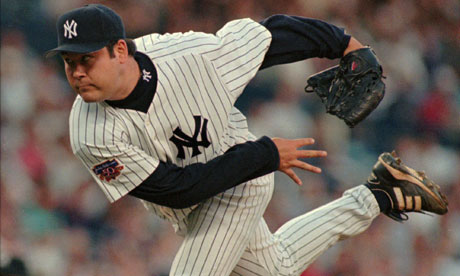 |
| Hideki Irabu pitched for three tumultuous seasons with the New York Yankees. |
"Guess who died today? I'll give you a hint, he played for the Yankees."
"Uhh, Yogi Berra?"
"Think more recently. More in the nineties...It was someone who flamed out."
"Oh! Uhh, the catcher that was recently arrested for DUI...Jim Leyritz?
"No not him. Think Japanese...Think high expectations."
"Hideki Irabu! Ohh! Yeah, wow, what a disappointment he turned out to be."
----------
Hideki Irabu, one of the most hyped players in baseball history, committed suicide in his Los Angeles home on Thursday. He was 42.
Irabu had great stuff. He pitched from 1988-1996 in Japan's Pacific League, holding an ERA near 2.00 and routinely throwing 95+ mph fastballs, unheard of in Japanese leagues at the time. But the "Nolan Ryan of Japan" wanted to play in the United States, specifically for the World Champion New York Yankees.
Privately, Irabu also yearned to explore his American roots and desperately wanted to meet his estranged biological father. He was US military personnel and disappeared before Irabu was born.
He had stated that it was "his dream" to play for the Yankees, yet when he arrived in New York, he remained introverted, even sad. He never met his father, and he never quite felt "at home" in New York.
While he had flashes of brilliance, Irabu caved spectacularly under the weight of expectations.
His first year in the league, 1997, was marred by inconsistency. After striking out nine in his much-anticipated debut, he unspectacularly racked up a 7.09 ERA over the rest of the season.
In 1998, he gave fans glimpses of his vast talent, posting a 13-9 record with an ERA just over 4. Yet, he didn't appear in a single game during the Yankees' sensational playoff run that year.
In 1999, after failing to cover first during an exhibition game, owner George Steinbrenner famously called Irabu a "fat pus-sy toad," a jeer that was only amplified by the lax workout regimens that supposedly contributed to the japanese import's lack of success on American soil. Unlike the aforementioned Yogi Berra, Irabu had difficulty dealing with criticism and channeling it into positive results.
In the 1999 ALCS, Irabu made his only postseason appearance. Against the Red Sox, the mild-mannered pitcher was pounded for eight runs in four and two thirds innings in a 13-1 loss, the only one of the series. The Yankees would go on to capture the World Series, earning Irabu his second ring.
From the end of that season, Irabu's storyline was relegated to the backpages of the sports section. He was traded to the Montreal Expos but only made 14 starts over a two year period. In 2001, Irabu was suspended for getting drunk before a scheduled start during a rehab assignment.
In 2002, the Texas Rangers tried to convert Irabu into a closer, but to no avail, as he finished the season with an ERA of 5.74 with only 16 saves to show for it. He returned to Japan for the 2003 season with mild success, but retired shortly thereafter.
Irabu faced more troubles in connection with his drinking habits. On August 20, 2008, he pounded 20 beers and decked a bartender in Osaka, Japan when his credit card was rejected. The bartender didn't press charges.
In 2009, he returned to American soil in the independent Golden Baseball League, but in 2010, he returned to Japan for his final professional season.
On May 20, 2010, Irabu was arrested for DUI, just another incident in a long line of precursors leading up to his eventual death.
----------
When I think of Hideki Irabu, I don't envision the man who retreated in his empty suburban home, his daughters taken away and his marriage in tatters, to hang himself.
I take the leap back to childhood.
As an eight-year-old boy who eagerly devoured every bit of Yankee lore, past and present, Hideki Irabu was one man in a lineup of superheroes who were paid the big bucks to throw flaming fastballs and smash towering home runs, day in and day out.
When I hear his name, the memories that resurface are those of the fanfare of his arrival at Yankee Stadium, of his high-90s heaters, and of his contributions to the spectacular '98 and '99 Yankees squads.
But still, it remains hard to celebrate the life of a man who gave up, who could never measure up to the hype he helped build, whose only steady relationship was with the bottle, who took the coward's way out, selfishly leaving his two daughters to grow up fatherless, like he was.
Hate the column? Love the column? Send us an email at jabronifreesports@gmail.com.
Dean Karoliszyn is the Coeditor-in-Chief and cofounder of Jabroni Free Sports.
Sunday, July 24, 2011
NBA Lockout: The View From Across The Pond
 |
| Besiktas has assembled exactly one-half of an NBA dream duo. |
As ESPN.com's NBA insider and intel guru Chris Broussard reported Thursday, an anonymous agent pointed out that 80 percent of the league's players are (mostly privately) pursuing contracts with European and Chinese teams. Superstar players are now looking outside the borders of this country, following the example set by the Nets' Deron Williams and the Hawks' Zaza Pachulia, who both signed with the Turkish club Besiktas earlier this month.
In the past few days, Besiktas has revived its pursuit of the Lakers' Kobe Bryant, and the agents representing the star shooting guard have reached out to the Turkish basketball club. While it seems like the two parties have a mutual goal, there are still roadblocks to a potential deal. According to this report on ESPN.com, Besiktas has offered $500,000 per month, but Bryant's agent is asking for $1 million. Also, issues are cropping up over insuring his massive contract, should injury arise (the premiums for which would be astronomical), and subsidizing his paycheck with an endorsement deal.
Other NBA stars are looking overseas as well. Dwight Howard, Dwyane Wade, and Kevin Durant have all indicated that they'd be receptive to offers from European or Chinese teams.
Now, there are two sides to the debate over players taking their talents abroad: fantasy and reality.
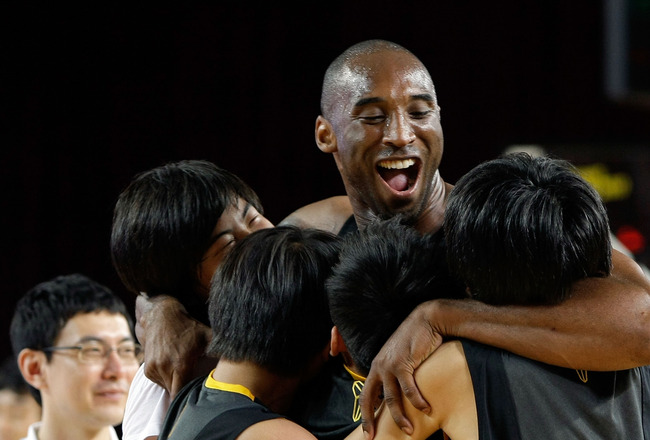 |
| Future starting five for the Liaoning Dinosaurs? |
Sorry to poke holes in your (and your agent's) glamorous fantasy, Kobe, but overseas ball is not all fun and games.
In light of the expected exodus, former and current American players have been speaking out about their experiences abroad. The Phoenix Suns' Josh Childress, who played two years for the Greek club Olympiakos, offered some words of caution in an interview with ESPN Radio Los Angeles.
"It's a different style of play, mentality, overall just a completely different animal. And I think you get some situations where some coaches, you're going to get two-a-days every day, and you're going to be playing one game a week, one to two games a week. It's just different. There's not a ton of things I can say about it other than it's just different and that you're aware of that. I wouldn't want guys going over there thinking it's like the NBA, because it's not."The Bucks' Brandon Jennings, who sidestepped college for a season of pro hoops in Italy, isn't eager to head back overseas. In a text to Broussard, Jennings noted, "Right now, I'm just grinding and staying in the weight room. I wouldn't mind going back overseas if it's the right situation. And I would have to get paid everything up front.''
Once the initial euphoria of balling in a foreign land fades, players will find themselves unaccustomed to two-a-day practices, sharing a room with a teammate, rowdy and sometimes violent fans, and, as Jennings references, unreliable methods of payment.
Josh Boone, a former UConn Husky and former New Jersey Net, now of the Zhejiang Chouzhou Golden Bulls of the Chinese Basketball Association, sat down with Chris Sheridan for a chat. While Boone insists that a player like Dwight Howard would be treated like a king in China, he sheds light on the culture shock that inevitably hits American imports, including curfews, limited internet access, weird foods, isolation, inflated expectations, and caps on playing time and the number of American players allowed on teams (three quarters and two, respectively).
With the glut of players competing for jobs overseas, these problems could be compounded.
European and Chinese teams don't have NBA money, so salary expectations have to be modest, even for the most talented players out there. They may not be as eager to open their wallets to "rent-an-NBA-player," who could show up and leave as quickly as he comes. Roster slots may be available only to the best the NBA has to offer. Other players may have trouble competing with foreign-born NBA players, NBA players with overseas experience, and those who choose to leave the NBA behind for good (example: Celtics center Nenad Krstic signed a two-year deal with CSKA Moscow with no opt-out clause). Players could face difficulty negotiating a clause into their contracts that would allow them to return to the U.S. when the lockout ends.
Although the NBA is still head-and-shoulders above the worldwide circuit, leagues across the world have developed significantly in the last decade. The level of competition is higher, fans are more passionate, and coaches and owners care more about winning. Having "NBA Player" on your resume will no longer bring team owners to their knees to beg for your services. If Kobe Bryant, one of the best players ever and one of the most visible athletes on the planet, is having trouble navigating a satisfactory deal overseas, then that spells trouble for other, less talented, and slower-to-react players.
 |
| Hasheem could go the 'tea and crumpets' route. |
Here's some advice for NBA players: stay healthy, maintain your fitness, and consider doing as Baron Davis does...exercise your brain!
As for Kobe, if he cherishes his remaining time in the NBA, he should hold off on making plans for a Euro trip. Going into his 16th season, he can't afford to put extra mileage on his weary and injury-prone body. This time off the court should be spent getting completely healthy, so he can be ready to guide the Lakers into the Mike Brown era, and perhaps have one last shot at a MJ-tying sixth championship ring.
Hate the column? Love the column? Send us an email at jabronifreesports@gmail.com.
Dean Karoliszyn is the Coeditor-in-Chief and cofounder of Jabroni Free Sports.
Subscribe to:
Posts (Atom)